Resources
Substance use disorders:
My personal story with alcohol use disorder.
My relationship with alcohol began when I was 16 years old.
At first, it was simply something new. I was young, and like many people, I was curious about what alcohol might feel like. What I didn’t understand at the time was that I had discovered something that would become much more significant in my life.
I quickly learned that alcohol could change the way I felt.
It could quiet things I didn’t know how to quiet on my own. It could dull emotional pain, create distance from difficult feelings, and give me a temporary escape from things that felt overwhelming. I didn’t have the language or the tools to understand what was happening inside of me. I only knew that when I drank, I didn’t have to feel everything so intensely.
Alcohol became a way of coping.
What started as an occasional experience gradually became something I relied on. Over the years, my relationship with alcohol changed. It wasn’t simply something I did socially anymore. It became something I used to manage how I felt, to escape, to numb, and eventually just to get through certain moments.
For a long time, I didn’t necessarily see myself as someone who had an addiction. I could explain my drinking. I could minimize it. I could compare myself to other people. I could tell myself that I was functioning, working, taking care of responsibilities, and getting through life.
But addiction doesn’t always look the way we imagine it will.
For me, alcohol slowly became less of a choice and more of a dependence. The substance I had once discovered as a way to escape pain eventually created pain of its own.
Around 10 years, there came a point when I had to acknowledge that alcohol was no longer helping me. It was hurting me. I began to feel my body slowly dying. I had to face the hard truth that I needed to stop drinking. But how would I do this? I felt so lost at first. It was overwhelming to imagine how I could continue living without the very crutch that had been part of my life for over 30 years.
Sobriety was not simply about stopping drinking.
It was about learning how to live without the thing I had depended on for so many years. It meant learning to experience emotions without immediately trying to shut them down. It meant beginning to understand myself in ways I had avoided for a very long time. It meant learning that I could feel uncomfortable, hurt, angry, afraid, or overwhelmed—and survive those feelings without reaching for alcohol.
Sobriety has given me something alcohol never could: the ability to be fully present in my own life.
I have now been sober for many years, and at the end of 2027, I will reach ten years.
Ten years.
Sometimes I still have to let that number sink in.
The girl who first discovered alcohol at 16 could never have imagined the woman she would eventually become without it.
My sobriety has not erased my past. It has not erased difficult experiences or made life perfect. It has given me a different relationship with myself. I no longer need alcohol to create distance between myself and my feelings. I am learning that I can face difficult things without abandoning myself.
I don’t tell my story because I believe there is one way to recover from addiction.
I tell it because addiction can happen quietly. It can begin long before we recognize what it is. Sometimes the substance isn’t initially about wanting to get drunk. Sometimes it is about wanting to feel less, hurt less, think less, or simply get through the day.
For me, alcohol began as a way to numb pain.
Eventually, sobriety became a way to feel my life again.
And after all these years, I am still learning what that means.
SUD’s Resource Guide:
My personal experience with alcohol addiction has also influenced the work I do today.
Through my work in integrative therapies and, specifically, as a Healing Touch practitioner and instructor, I have the opportunity to work alongside people who may be experiencing substance use disorders. I believe that people deserve to be met with compassion, dignity, respect, and understanding—not judgment.
I wanted to create something that could help practitioners and other caring professionals feel more comfortable and informed when supporting someone who is affected by substance use.
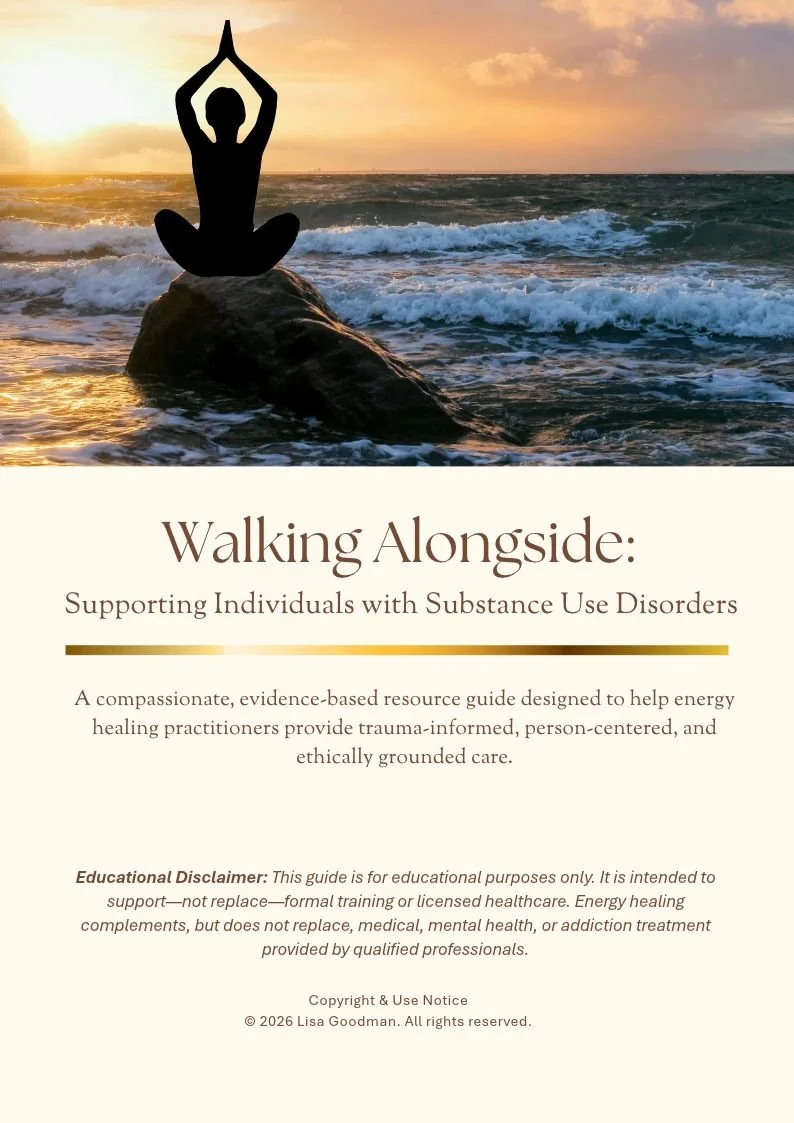
So I created Walking Alongside: Supporting Individuals With Substance Use Disorders.
This resource guide is offered completely free. My hope is that it can be a practical resource for anyone who wants to better understand how to compassionately navigate their work with individuals who are living with or affected by substance use.
You are welcome to download it, use it as a resource, and share the link with others who may find it helpful.
I simply ask that you please do not copy, reproduce, sell, modify, or present the guide as your own work. This resource was created from my own experience, education, and professional perspective, and I am offering it freely because I believe helpful information should be accessible to those who need it.
If this guide helps even one person approach someone struggling with substance use with a little more compassion, understanding, and hope, then creating it was worth it.
with love, Lisa
Substance Use disorder resource guide